


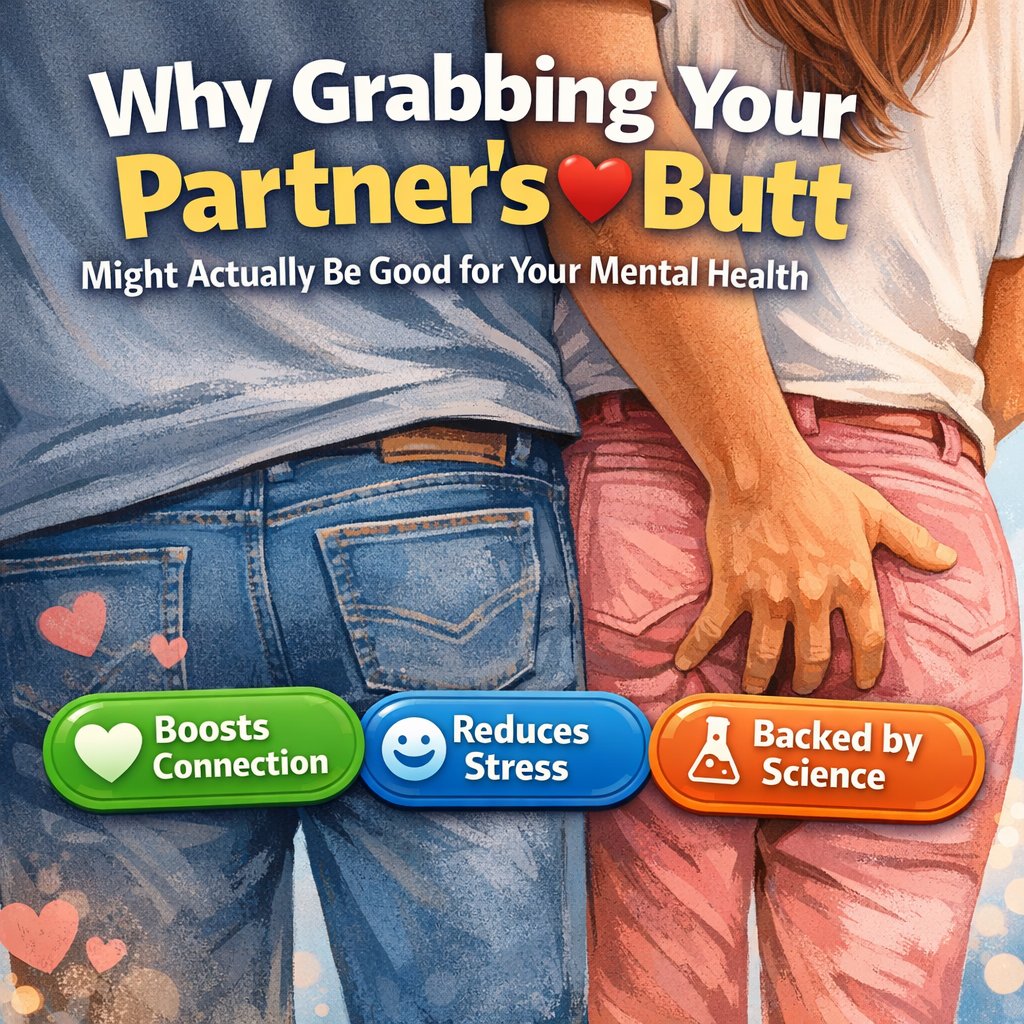
A humorous, evidence‑informed perspective from a mental‑health professional in Lakeland, FL
The Small Gesture Couples Rarely Talk About (But Everyone Does)
Affectionate touch is one of the most powerful, underused tools couples have for emotional connection. And yes — that includes the playful, consensual grab of your partner’s backside. While it doesn’t appear in treatment plans or diagnostic manuals, it shows up constantly in real relationships across Lakeland, Polk County, and everywhere else humans try to love each other well.
From a clinical standpoint, this tiny gesture sits at the intersection of attachment, nervous‑system regulation, and relational bonding. From a human standpoint, it’s also funny, sweet, and sometimes the only form of communication two adults can manage before coffee.
The Science of Affectionate Touch
Oxytocin and Emotional Bonding
Affectionate touch increases oxytocin, the hormone associated with bonding, trust, and emotional safety. A 2023 study found that affectionate touch was linked to increased oxytocin and decreased cortisol, along with reduced anxiety and stress.
Stress Reduction Through Social Safety
Touch acts as a “social safety signal,” reducing activation of the body’s stress system (the HPA axis). Research shows affectionate touch can lower cortisol and activate reward‑related brain regions.
Affective Touch Pathways
Slow, gentle, playful touch activates C‑tactile (CT) afferent fibers, which are specialized for emotionally meaningful touch. These fibers are linked to pleasantness, bonding, and emotional regulation.
A butt‑grab may be humorous, but the underlying neurobiology is serious.
Relationship Benefits (With a Wink)
Signals Presence and Interest
Touch communicates: “I’m here. I see you. I still like you.” This reinforces secure attachment and emotional safety.
Breaks Tension and Interrupts Stress Cycles
Humor and light physical affection can interrupt escalating stress patterns between partners. It’s a micro‑reset button.
Supports Secure Attachment
Playful, other‑directed touch aligns with research showing that adult playfulness predicts lower avoidant attachment and healthier relational functioning.
Builds Emotional Flexibility
Playfulness in relationships is associated with satisfaction, resilience, and the ability to reframe stressors.
Humor as a Relationship Regulator
Life is full of stressors — work, kids, bills, and the never‑ending laundry pile. Humor acts as a pressure valve, and when paired with affectionate touch, it becomes a moment of co‑regulation.
Research on adult playfulness shows that couples who maintain shared humor and lightheartedness tend to have higher relationship satisfaction and better conflict recovery.
A playful squeeze can be a shared inside joke, a moment of levity, or a reminder that intimacy isn’t only serious — it’s also silly, warm, and human.
Touch as Nervous‑System Regulation
Parasympathetic Activation
Touch can activate the parasympathetic nervous system, lowering heart rate and supporting calm.
Social Grooming Parallels
Research on ASMR suggests that certain sensory experiences mimic the calming effects of social grooming behaviors, reducing pulse rate and promoting relaxation.
Attuned Touch Matters
Studies on caregiver–infant touch show that responsive, attuned touch increases vagal tone and reduces stress. While adult relationships differ, the underlying mechanisms of co‑regulation remain relevant.
A playful grab may be brief, but it can cue the body to shift out of stress and into connection.
Consent: The Clinical Non‑Negotiable
Affectionate touch is only healthy when it is:
- Consensual
- Mutually welcomed
- Contextually appropriate
- Emotionally safe
Touch should never be assumed or used to bypass boundaries. The goal is connection, not entitlement.
Micro‑Moments Build Stronger Relationships
In therapy, we talk about communication, attachment, and emotional safety — but relationships are built just as much on micro‑moments as macro‑conversations.
A consensual, playful squeeze can be:
- A grounding cue
- A bonding moment
- A stress‑relief tool
- A reminder of shared humor
- A signal of ongoing desire and appreciation
These tiny gestures accumulate, shaping the emotional climate of a relationship over time.
For Couples in Lakeland and Polk County, Florida
Couples in Lakeland, Highland City, Bartow, Winter Haven, and across Polk County often come to counseling wanting to feel more connected, more playful, and more emotionally safe. Affectionate touch — even the silly kind — is one of the simplest ways to rebuild that sense of closeness.
If you’re noticing distance, stress, or disconnection in your relationship, these small moments matter more than people realize.
If you and your partner want to strengthen connection, rebuild playfulness, or learn healthier ways to communicate and co‑regulate, our team at Arkham Rise Counseling is here to help. You don’t have to navigate relationship stress alone — and sometimes the smallest moments create the biggest shifts.
Research References
Jakubiak, B. K., & Feeney, B. C. (2023). Affectionate touch is associated with reduced stress and anxiety and increased oxytocin. Psychoneuroendocrinology.
Feldman, R. (2012). Oxytocin and social affiliation in humans. Hormones and Behavior.
Coan, J. A., Schaefer, H. S., & Davidson, R. J. (2006). Lending a hand: Social regulation of the neural response to threat. Psychological Science.
Morrison, I. (2016). Social touch as a stress buffer. Current Opinion in Behavioral Sciences.
McGlone, F., Wessberg, J., & Olausson, H. (2014). Affective touch and the CT afferent system. Neuroscience & Biobehavioral Reviews.
Proyer, R. T. (2017). A new structural model for adult playfulness. Personality and Individual Differences.
Brauer, K., & Proyer, R. T. (2020). Adult playfulness and romantic relationships. Journal of Social and Personal Relationships.
Diego, M. A., Field, T., & Hernandez-Reif, M. (2009). Vagal activity and massage therapy. International Journal of Neuroscience.
Poerio, G. L., et al. (2018). ASMR and physiological response. PLOS ONE.